Counter-UAS
Airport Counter-Drone Programs Move From Jamming to Layered, Evidence-Graded Detection
After years of ad-hoc trials, airports are building permanent detection architectures that fuse radio frequency, radar, acoustic and optical data, while regulators slowly define who may actually take a drone down.
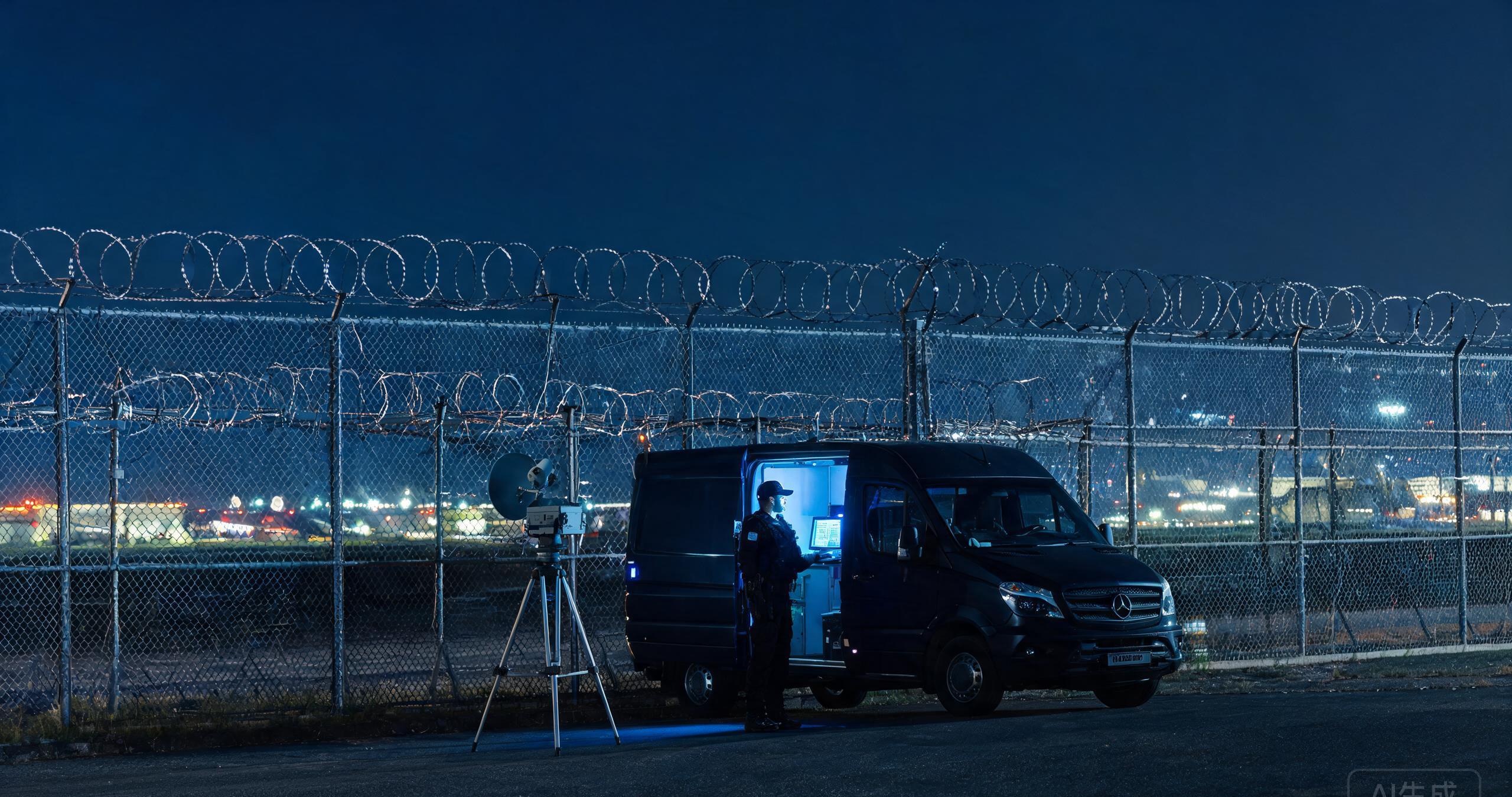
In December 2018, a reported drone sighting over Gatwick Airport shut the runway for more than thirty hours, diverted or cancelled roughly a thousand flights and disrupted about 140,000 passengers. The culprit was never convicted, and the incident became the founding trauma of airport counter-drone planning. Since then, airports have spent years experimenting with detection vans, handheld jammers and temporary radar, often without a clear legal pathway to act on what they detected.
That is changing, unevenly. The FAA Reauthorization Act of 2024 included provisions that expand limited counter-UAS authorities for airports, allowing them, under conditions and after coordination with federal agencies, to detect and mitigate certain drone threats. The statutory language is narrow and the implementing guidance is still being written, but it moves airports from pure observation toward a defined role in the response chain. At the same time, the FAA's UAS Detection and Mitigation Systems Aviation Rulemaking Committee has been working through the standards question: what counts as adequate detection, how systems should be tested, and how to avoid interfering with safe aviation.
The detection stack itself has matured. Radio-frequency sensing, the workhorse of the first generation, listens for the control and video links that consumer drones use in the 2.4 and 5.8 gigahertz bands. Products from Dedrone, now part of Axon, and DroneShield can identify a drone's make by its radio fingerprint and, in some cases, locate the pilot by triangulating the signal. The weakness is obvious: a drone flown autonomously on a pre-programmed route, or one using a cellular link, emits nothing to listen to.
Radar fills part of that gap. Small active electronically scanned arrays, such as those built by Echodyne, and specialized counter-UAS radars like Robin Radar's Elvira are designed to detect low, slow, small targets that conventional airport surveillance filters out. The engineering problem is clutter: terminals, cranes, birds, wind turbines and heavy precipitation all return echoes, and the classifier that separates a quadcopter from a flock of geese is doing real work. Acoustic arrays add another modality at short range, and electro-optical and infrared cameras provide the visual evidence that an operations center needs before it escalates.
Fusing those modalities is where the market has moved. A single sensor produces tracks; a fusion engine produces a decision. The better installations correlate RF, radar and optical detections into a single track with a confidence score, display it on a map alongside crewed traffic, and push alerts to airport operations, local police and the FAA in a defined sequence. The difference between a nuisance and a closure is often whether the operations center can say with confidence that the object is a drone, where it came from and where it is going.
Mitigation remains the legally delicate half of the problem. Radio-frequency jamming is broadly prohibited in the United States outside specific federal authorities, and even where it is permitted, jamming a control link can trigger a drone's failsafe behavior, which may be to hover, land or return to its launch point rather than to leave the airspace. Protocol-level takeover and spoofing raise their own legal and safety questions, and kinetic interception over a populated area is unacceptable in almost every scenario. Most airports therefore plan for containment and continuity: notify, locate the operator, protect the runway, and hand the response to law enforcement with a clear evidentiary record.
Remote identification has helped at the margin. Since the compliance deadline in 2023, most consumer drones sold in the United States broadcast identity, position and launch location, and airports can receive that data with inexpensive receivers. The technology is a powerful tool against careless operators and a weak one against deliberate ones, who can disable broadcast or build aircraft that never transmit. Counter-UAS planning therefore assumes a spectrum of adversaries, from the oblivious tourist to the sophisticated criminal.
Cost and governance are the deciding factors for most airports. A permanent layered installation at a mid-size airport can run into the low millions of dollars, plus a substantial annual operations and maintenance line, and the staffing model for a twenty-four-hour fusion center is not trivial. Smaller airports are more likely to buy into regional or shared service arrangements, or to rely on mobile systems deployed during high-profile events. Insurance carriers and airport certification requirements are beginning to push the other direction, treating detection coverage as part of a duty of care.
The next phase is certification and standardization. Detection systems that claim to see everything are difficult to evaluate, and regulators want repeatable test protocols, defined probability-of-detection curves and interference assessments before they will treat a system as infrastructure rather than a gadget. The airport counter-drone market is therefore consolidating around vendors who can document performance against published standards and integrate with the existing air traffic picture, rather than those with the most impressive demonstration video.
Related briefings
More from
Counter-UAS
Regulatory & Policy
Part 108 Rewrites the Economics of Flying Beyond Visual Line of Sight
The FAA's performance-based BVLOS framework is moving approvals away from one-off waivers and toward aircraft-level standards, changing what delivery, inspection and emergency operators can plan for.

Wildfire Response
Satellites, Camera Networks and Long-Endurance Drones Compress Wildfire Detection to Minutes
A layered detection stack of hilltop cameras, thermal satellites and fixed-wing drones is shrinking the gap between ignition and dispatch, while airspace coordination and false-alarm filtering remain the hard problems.

Emissions Monitoring
Drone-Based Methane Audits Become the Default Evidence for Emissions Compliance
Tightening federal methane rules and a rising waste-emissions charge are turning drone-borne laser spectroscopy from a pilot project into the routine evidentiary layer for oil and gas operators.