Offshore Logistics
Cargo Drones Quietly Replace Supply Vessel Runs on North Sea Platforms
Offshore operators are moving spare parts and consumables by air under beyond-visual-range approvals, turning multi-hour boat transfers into twenty-five-minute hops and cutting fuel burn.
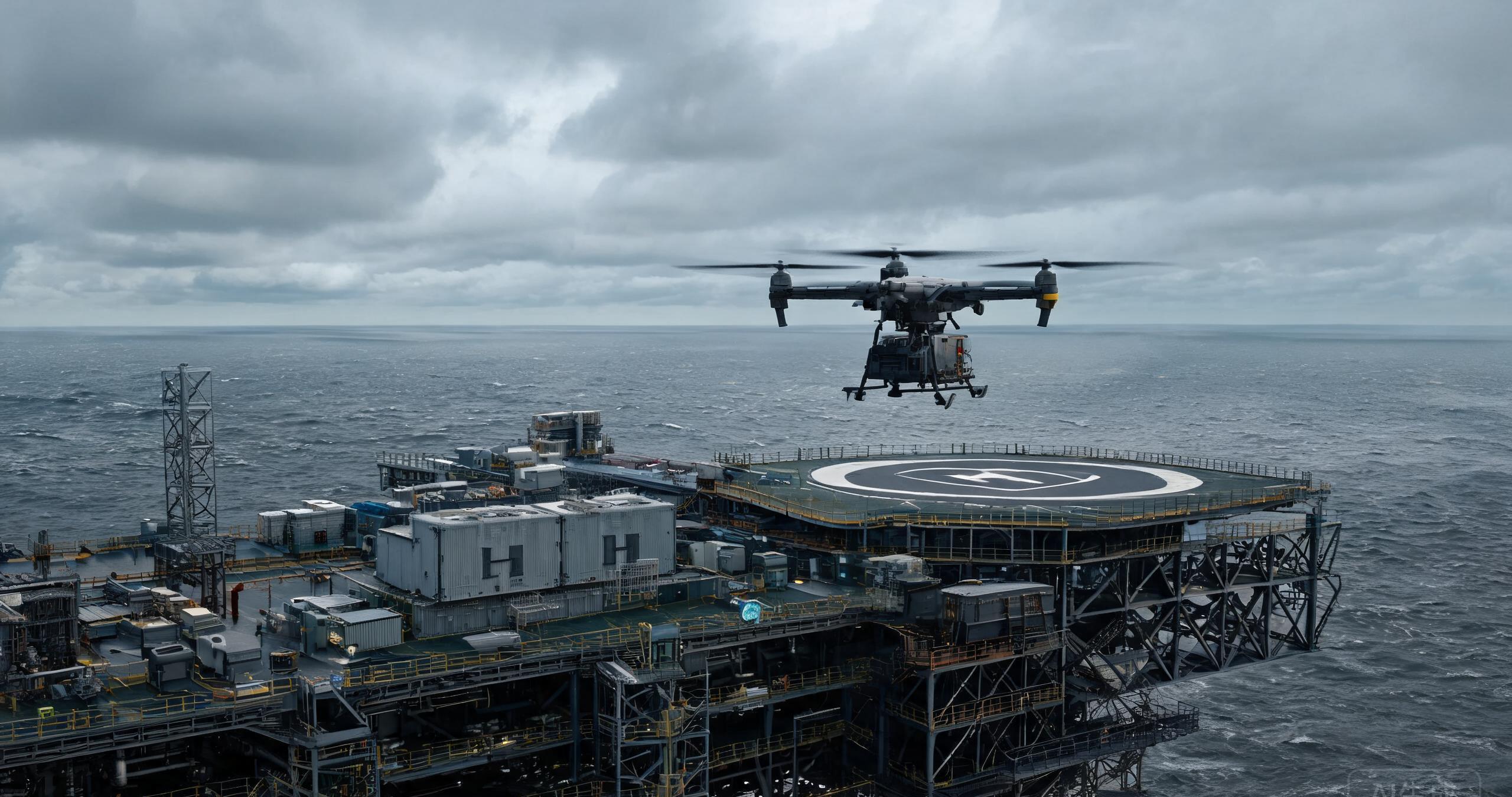
A four-hundred-dollar pump seal can idle a platform producing a million dollars of hydrocarbon a day. That asymmetry, small part, enormous consequence, explains why offshore operators have tolerated the slow and expensive logistics chain that supports them: supply vessels that take hours to reach an installation, helicopters that cost thousands of dollars per seat, and warehouse inventories duplicated across every asset because waiting for a delivery is unacceptable.
Cargo drones are beginning to change that chain, not by replacing helicopters or vessels but by absorbing the small, urgent slice of the workload they handle worst. A heavy-lift multirotor carrying twenty-five to fifty kilograms can move a critical spare, a calibration gas cylinder, medical supplies or a laptop from an onshore base to a platform fifty kilometers offshore in under half an hour. The same trip by vessel might take four to six hours each way and consume hundreds of liters of marine diesel.
The hardware required is less exotic than the operating environment. Airframes are typically sealed to IP55 or better, with corrosion-resistant structures, redundant flight controllers and redundant command links. Payloads are carried in enclosed pods rather than slung, because salt spray and wind are unforgiving. Landing on a platform is the hard part: the aircraft must manage turbulence around large steel structures, avoid crane paths and flare stacks, and either land on a marked area or hover while deck crew retrieve the pod. Emergency flotation and a controlled-ditching procedure are mandatory elements of the safety case.
Regulation has been the enabler. Norway's Civil Aviation Authority has approved beyond-visual-range operations for offshore logistics under specific conditions, and the UK Civil Aviation Authority has developed a pathway through its specific category and predefined risk assessment process. The approvals are route-specific and weather-limited, but they are operational, not experimental. Operators file a risk assessment that covers mid-air encounter with helicopters, loss of command link, dropped objects and emergency response, and they demonstrate conformance through flight data monitoring.
Operations are governed by weather windows that would surprise a landsman. Wind limits are typically around ten to fifteen meters per second, and gusty conditions near a platform can exceed that at drone altitude even when the surface report is benign. Icing, lightning and fog stop flights entirely. Deck crew training is as important as pilot training: a person who has spent a career receiving helicopters must learn to stand clear of a multirotor's downwash, to guide a hover-release with hand signals and to secure a pod in seconds.
The economics are strongest where the alternative is a vessel voyage. Chartering a supply vessel can cost tens of thousands of dollars a day, and a single unscheduled run for a forgotten part can cost more than a year of drone service. Operators also count the emissions avoided, which matters increasingly as North Sea regulators tighten reporting requirements and as lenders scrutinize Scope 1 and Scope 3 footprints. A drone flight produces a small fraction of the carbon dioxide of a vessel trip for the same payload.
The service model is still being sorted out. Some operators sell flights, billing per delivery in the way a launch service bills per satellite; others sell availability, keeping an aircraft and crew on standby at a shore base and charging a monthly retainer plus flight hours. The availability model is easier for an offshore asset manager to budget, but it requires the operator to absorb weather downtime, which is substantial in the North Sea. Contracts are increasingly written with defined weather thresholds and minimum dispatch rates, so that both parties share the risk of a bad month rather than arguing about it after the fact.
Maintenance is the hidden cost of the model. Salt air corrodes connectors, hinges and motor bearings faster than any laboratory accelerated-ageing test predicts, and an aircraft that lives near the coast needs a disciplined washdown, inspection and parts-replacement cycle. Most operators therefore keep spare airframes ashore rather than relying on a single unit, and they treat component life limits as hard stops instead of recommendations. The resulting cost per flight hour is higher than a warehouse or agricultural operation would recognize, but it is still low relative to the vessel voyages it displaces.
The programs that have advanced furthest combine drones with existing marine logistics rather than replacing them. Crew change remains a helicopter mission, because a drone cannot safely carry six people and their baggage in North Sea weather. Bulk cargo, fuel and drilling consumables still move by vessel. What the drone takes is the urgent, light, high-value fraction, and in doing so it reduces the number of unscheduled vessel runs, the largest source of avoidable logistics cost.
Offshore wind has become the second market. Inspection drones flying blade and nacelle surveys are routine, and cargo drones are beginning to move tools and small components between service operation vessels and turbines, avoiding the need for a crew transfer vessel to reposition for a single task. The combination of drone delivery and drone inspection turns a service vessel into a mobile base rather than a shuttle.
The next step is residency. Docked systems installed on platforms or on nearby unmanned installations would allow a drone to live offshore, charging from platform power and flying on demand without a launch crew. That model is technically feasible and regulatorily plausible, and it would collapse response time from hours to minutes. When a platform can summon a part from a dock on its own deck, the logistics chain that has shaped offshore operations for fifty years will finally have a faster alternative.
Related briefings
More from
Offshore Logistics
Regulatory & Policy
Part 108 Rewrites the Economics of Flying Beyond Visual Line of Sight
The FAA's performance-based BVLOS framework is moving approvals away from one-off waivers and toward aircraft-level standards, changing what delivery, inspection and emergency operators can plan for.

Wildfire Response
Satellites, Camera Networks and Long-Endurance Drones Compress Wildfire Detection to Minutes
A layered detection stack of hilltop cameras, thermal satellites and fixed-wing drones is shrinking the gap between ignition and dispatch, while airspace coordination and false-alarm filtering remain the hard problems.
Counter-UAS
Airport Counter-Drone Programs Move From Jamming to Layered, Evidence-Graded Detection
After years of ad-hoc trials, airports are building permanent detection architectures that fuse radio frequency, radar, acoustic and optical data, while regulators slowly define who may actually take a drone down.