Critical Infrastructure
Drone-in-a-Box Becomes the Night Shift at AI-Era Data Centers
Autonomous docked drones are taking over repetitive perimeter and thermal patrols at hyperscale campuses, where security headcount is lagging behind a record wave of construction.
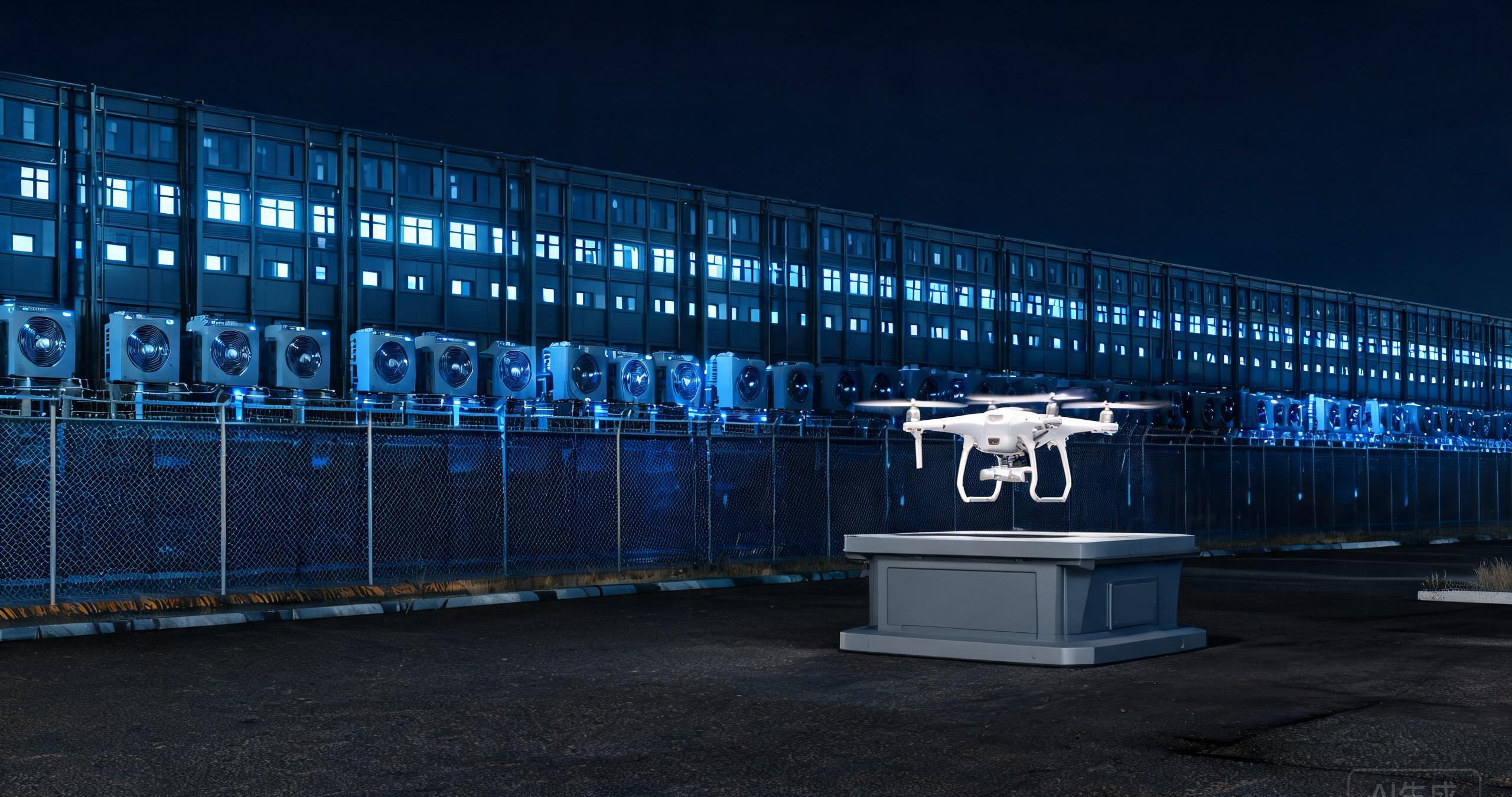
The physical security industry has a straightforward staffing problem. A hyperscale data center campus can have a perimeter measured in miles, dozens of exterior doors, a substation, a water treatment plant and a yard full of diesel generators, all of which need to be checked on a schedule. Guard forces are expensive, turnover is high, and the overnight shift, when most intrusions and thermal faults would go unnoticed, is the hardest to staff. The result is that a growing number of operators have handed part of that shift to a drone that lives in a box on the roof.
The architecture is deceptively simple. A weatherproof docking station sits on a pad near the perimeter or on a building roof. It holds one or more aircraft, charges their batteries, and conducts automated pre-flight checks: enclosure seals, propeller integrity, sensor calibration, communications link quality. On a schedule or on alarm, the dock opens, the aircraft takes off, flies a pre-programmed mission, streams data to a remote operations center and returns to recharge. A single dock can support continuous coverage if the mission cadence and battery swap strategy are designed correctly.
The platforms serving this market are now mature enough to be procured rather than piloted. Percepto, which pioneered the category with autonomous docking systems and received early regulatory relief for beyond-visual-range operations, has installed systems at industrial and utility sites around the world. Skydio's Dock for the X10 pairs an American-made airframe with onboard autonomy and obstacle avoidance, and DJI's Dock 2 has brought the hardware cost down for operators already inside that ecosystem. American Robotics, part of Ondas Holdings, built its business on FAA approvals for automated beyond-visual-range inspection, and Nokia has packaged drone docking into private wireless networks for industrial campuses.
The mission set is broader than perimeter patrol. Thermal cameras mounted on the aircraft inspect transformers, switchgear, uninterruptible power supply rooms and generator exhausts for hot spots that precede failures. A rising winding temperature on a medium-voltage transformer, invisible to a guard walking past, shows up clearly in a radiometric image and can trigger a maintenance ticket before the equipment trips. Optical zoom lenses read fence-line conditions, detect standing water after storms, and document contractor activity. LiDAR and photogrammetry can produce a survey-grade model of the yard that is refreshed monthly, giving facilities teams a change-detection baseline.
Regulation remains the gating factor, particularly in the United States. Night operations under Part 107 are permitted with anti-collision lighting, but routine patrols beyond the pilot's sight line still require waivers or, increasingly, the kind of performance-based approval contemplated by Part 108. Many data centers are rural enough that the airspace is uncontrolled and the risk profile is low, which makes waiver applications straightforward. Urban campuses near airports face a harder problem, and some operators respond by keeping the aircraft within a shielded perimeter or flying only under a visual observer. The economics of the model depend heavily on how much of the site can be covered without a human outside.
Analytics are where the value is won or lost. A drone that produces four hours of video a night is a liability unless software converts that video into a small number of actionable events. The better installations combine thermal thresholds with trend analysis, compare current imagery against a baseline model, and route anomalies into the same ticketing systems that facilities and security teams already use. False positives are the enemy: a warm exhaust plume, a sunlit puddle or a visiting delivery truck can all generate alerts, and a system that cries wolf nightly will be ignored within a month.
The business case is straightforward arithmetic. A fully loaded security officer costs roughly sixty-five thousand dollars a year, and a twenty-four-hour post requires several of them. A docked drone installation might run one hundred thousand to two hundred thousand dollars in capital plus fifteen to thirty thousand dollars a year in maintenance and connectivity, and it covers far more ground per hour. Payback periods of eighteen to thirty months are common when the system replaces contract guard hours; they shrink further when thermal inspections avoid an unplanned outage.
Cyber security is the part of the conversation that vendors prefer to keep brief. A docked drone is a networked device with a camera, a cellular modem and an update channel, sitting inside a facility that may host customer workloads. Procurement teams now ask about encrypted command links, signed firmware, network segmentation and whether the aircraft can be forced to land if the link is lost. Remote identification compliance and clear data-retention policies are becoming standard requirements in enterprise contracts.
None of this eliminates human security. What it changes is the ratio. A single operations center can supervise dozens of sites, dispatching a guard only when a drone has produced evidence that a person is actually there, and the night shift stops being a tour of inspection and becomes a response function. In an industry building gigawatt campuses at record pace, that ratio is the only way the security function scales.
Related briefings
More from
Critical Infrastructure
Regulatory & Policy
Part 108 Rewrites the Economics of Flying Beyond Visual Line of Sight
The FAA's performance-based BVLOS framework is moving approvals away from one-off waivers and toward aircraft-level standards, changing what delivery, inspection and emergency operators can plan for.
Wildfire Response
Satellites, Camera Networks and Long-Endurance Drones Compress Wildfire Detection to Minutes
A layered detection stack of hilltop cameras, thermal satellites and fixed-wing drones is shrinking the gap between ignition and dispatch, while airspace coordination and false-alarm filtering remain the hard problems.
Counter-UAS
Airport Counter-Drone Programs Move From Jamming to Layered, Evidence-Graded Detection
After years of ad-hoc trials, airports are building permanent detection architectures that fuse radio frequency, radar, acoustic and optical data, while regulators slowly define who may actually take a drone down.